In this first lecture instructor, held on April 2, 2026, Apoorv Agrawal (currently Altimeter Capital, prev Palantir) goes over the format of the course and the purpose of the course with some primer concepts for the class. Anything that is my personal opinion will be denoted with italics.
Course Page Materials for this week:
- The Economics of Generative AI (2024)
- The Economics of Generative AI: Two Years Later
- State of Consumer AI Part 1
- State of Consumer AI Part 2
- State of Consumer AI Part 3
Format of the course
The course is primary guest speakers covering different areas of the current AI supercycle. Speakers are in areas such as GPUs, SaaS, infrastructure, etc.
Why take this course?
We are at the start of a massive supercycle. Agrawal makes the contention that this cycle will be larger than cloud, mobile, and the internet.
Where is the $ in AI today?
Agrawal asks some questions from the class then continues the rest of the time with a discussion.
Q: Is this CAPEX generating revenue?
A lot of money is going to CAPEX right now (capital expenditure), the so called 5 layer cake Jensen Huang has referred to (energy, chips, power, interconnect, memory). This CAPEX is amortized (at least for GPUs) over about 5-6 years. Is it worth it?
- Google: $100/user/year
- Meta: $70
- OpenAI: $10
How do you get to >$10 per user per year? Agrawal makes the point that knowledge work isn’t the answer, advertising is.
How this revolution is different
Software gets 80-90% gross margins. AI services at billions in revenue still isn’t profitable. Average margins for AI companies are much lower, around 30%.
Amazon took 8 years to build out AWS, and during that time people were asking if Amazon would go bankrupt. This is probably because Amazon had famously near 0 net profit for many years post IPO, instead focusing on reinvesting to increase revenue.
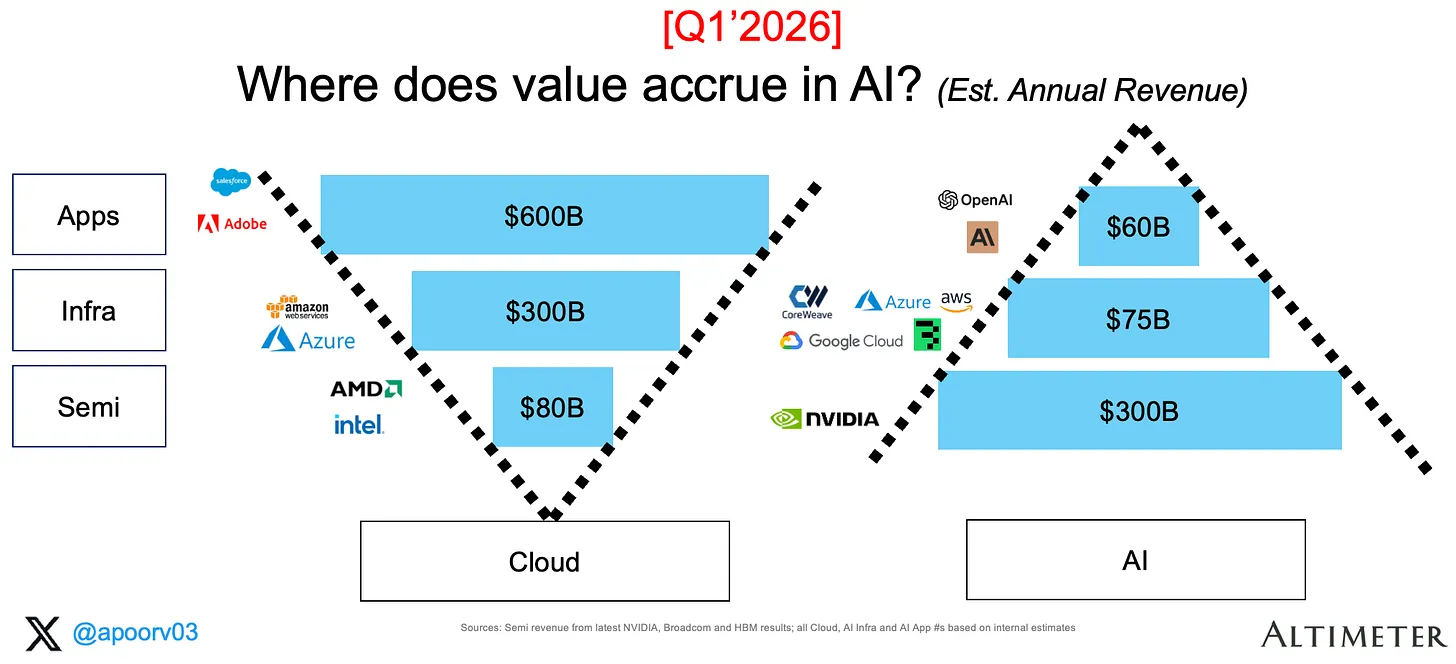
In cloud most value accrues in apps, but in AI its at the semiconductor layer. Agrawal states that gross margins for semis is 75% (0-30% for AI apps layer). This is the inverse of the cloud period. Also, semis are built for 5-6 year depreciation cycles, but apps generate revenue now. Mobile supercycle had the same inflated CAPEX early in the cycle.
Don’t underestimate Google
A student made a point that Google is one of the only complete AI stacks today, they have TPUs, apps, existing customer base, etc.
Agrawal makes the point to pay attention to earnings calls. CAPEX has an equilibrium (limited to free cashflow and cash reserves and also the expected revenue gains from additional CAPEX), so earnings calls will signal a change in this equilibrium.
This lecture was in April 2026 and this is somewhat prescient but perhaps underestimated the frothiness of the AI CAPEX splurge. Google just had its very first period of negative free cashflow since 2004.
Agrawal says:
- Google won the internet supercycle
- Apple won mobile
- Meta won social
- Oligopoly in cloud
Because of Google’s power in chips, apps, and existing customer base it might be likely that Google wins here.
Training and inference are unpredictable
Inference is dependent on when humans are awake, so this causes the usage to be unpredictable. This was how AWS got started (by using excess capacity since Amazon didn’t have traffic at night), so I feel like this isn’t as big of a problem as he states it is.
Where are all the ASICs?
ASICs are application specific integrated circuits. Groq (acquired by Nvidia in Dec 2025) and Cerebras (Jan 2026 deal with OpenAI) are two that come to mind.
There is 300 billion in revenue to go around. There wasn’t much discussion here around this topic, perhaps more in a later lecture.
Where will value accrue in AI?
2024: 90B vs 2026: 435B in revenue. But the shape of the revenue hasn’t changed much.
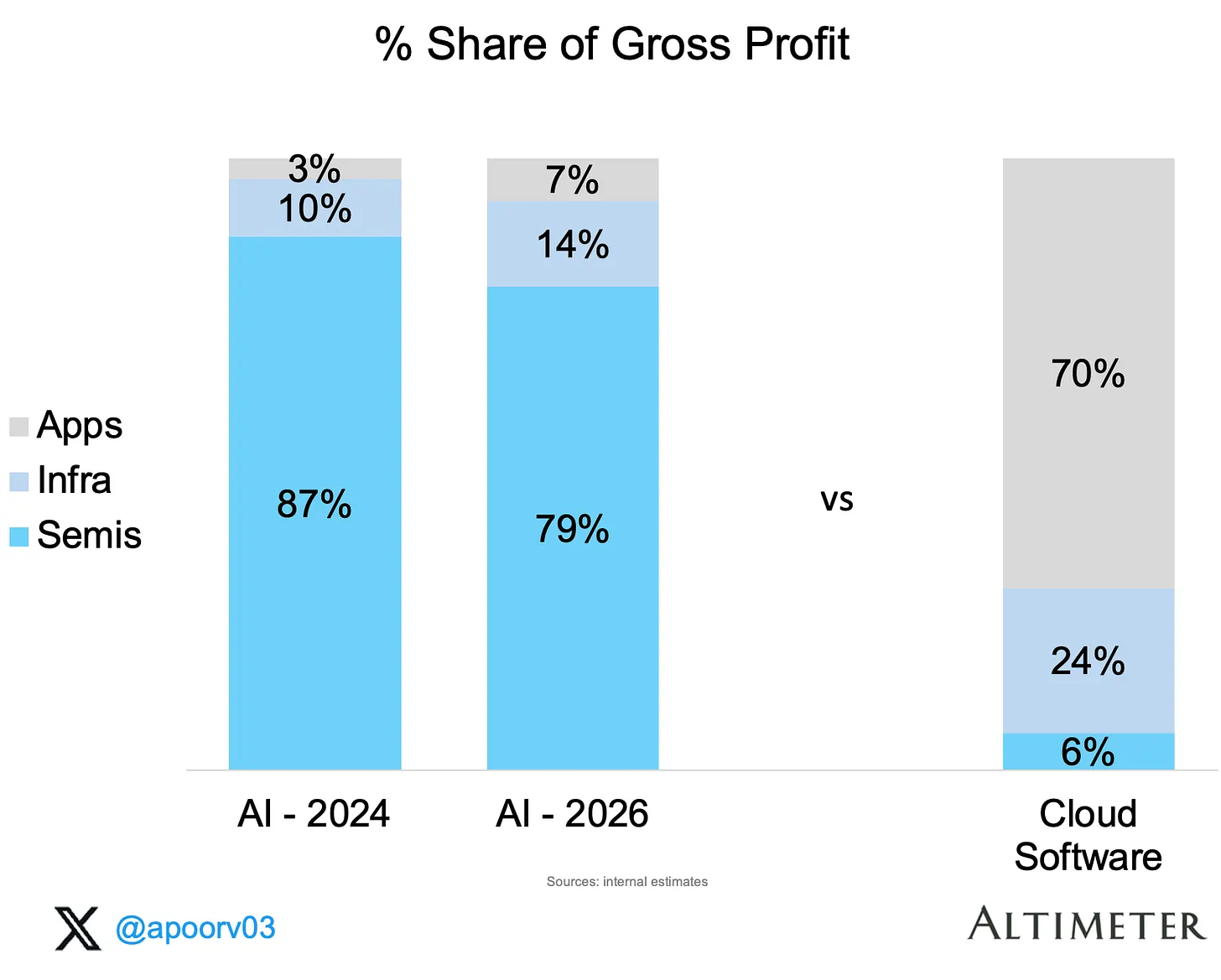
Yet profits remain in the semis later.
AI Apps - Weekly active users
ChatGPT has most users, then Gemini. Consumer apps are dwarfing ChatGPT, even with all of the hype.
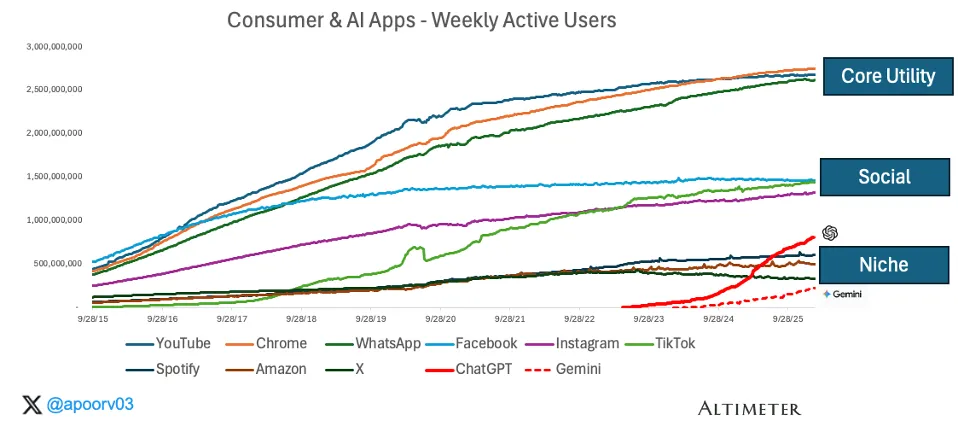
ChatGPT is closer to the niche app category (like Spotify and X) than it is to Netflix or YouTube.
Is knowledge work where most people are?
In ChatGPT you have to go and ask a question. This is very active and most people don’t prefer to engage in apps like this. To increase revenue Agrawal makes the point that these companies should use ads rather than subscriptions, and he thinks this is where it is heading.
Intent is much cleared in AI chat apps, so sure revenue per ad will be higher, but the inventory will be much lower as well.
Course notes
That’s it for this week. I’ll keep posting my course notes and comments on this page.
