Correction, August 13, 2026: The original version of this article reported a preliminary analysis of 75,323 cases, including a model built with automatically extracted aggravating and mitigating factors. A prediction-blinded publication audit found that those factor fields did not reliably measure the legal concept I intended. The same audit found that an extracted “probation” category had zero precision. I removed the factor model, excluded all 5,796 records carrying the invalid sentence label, restored the preregistered adult restriction, and rebuilt every affected result. This article now reports the audited analysis. The main employment finding remains, but several of my earlier claims did not.
Mongolia publishes criminal court decisions through shuukh.mn. That is an unusually valuable public record. It lets us ask a question that is studied extensively in the United States and Europe but rarely in Mongolia: after accounting for the case, are defendant demographics associated with sentencing?
I collected 80,827 criminal first-instance decisions dated from January 2020 through February 4, 2026. Of those, 77,968 contained usable decision text. After the publication audit and sentence-type correction, 69,527 cases remained in the cleaned dataset. The primary statistical analysis uses 29,132 adult cases with complete information on gender, age, education, employment, prior criminal record, crime category, and sentence severity.
That sequence of numbers matters. “Big data” has a habit of sounding more certain than it is. A dataset can contain nearly 70,000 rows and still depend on whether one field actually means what its name says.
How I compared different sentences
Mongolian courts impose fines, imprisonment, community service, and suspended sentences. To compare them, I converted each outcome to month-equivalents. For fines, the main conversion follows Article 5.3.5 of the Criminal Code: 15,000 MNT equals one day, or approximately 450,000 MNT equals one month. I tested alternative conversions, including the statutory community-service relationship in Article 5.4.
Fines are the most common outcome. They account for 42,517 of the 69,527 retained decisions, or 61%. Imprisonment accounts for 17%, community service for 11%, and suspended sentences for 11%.
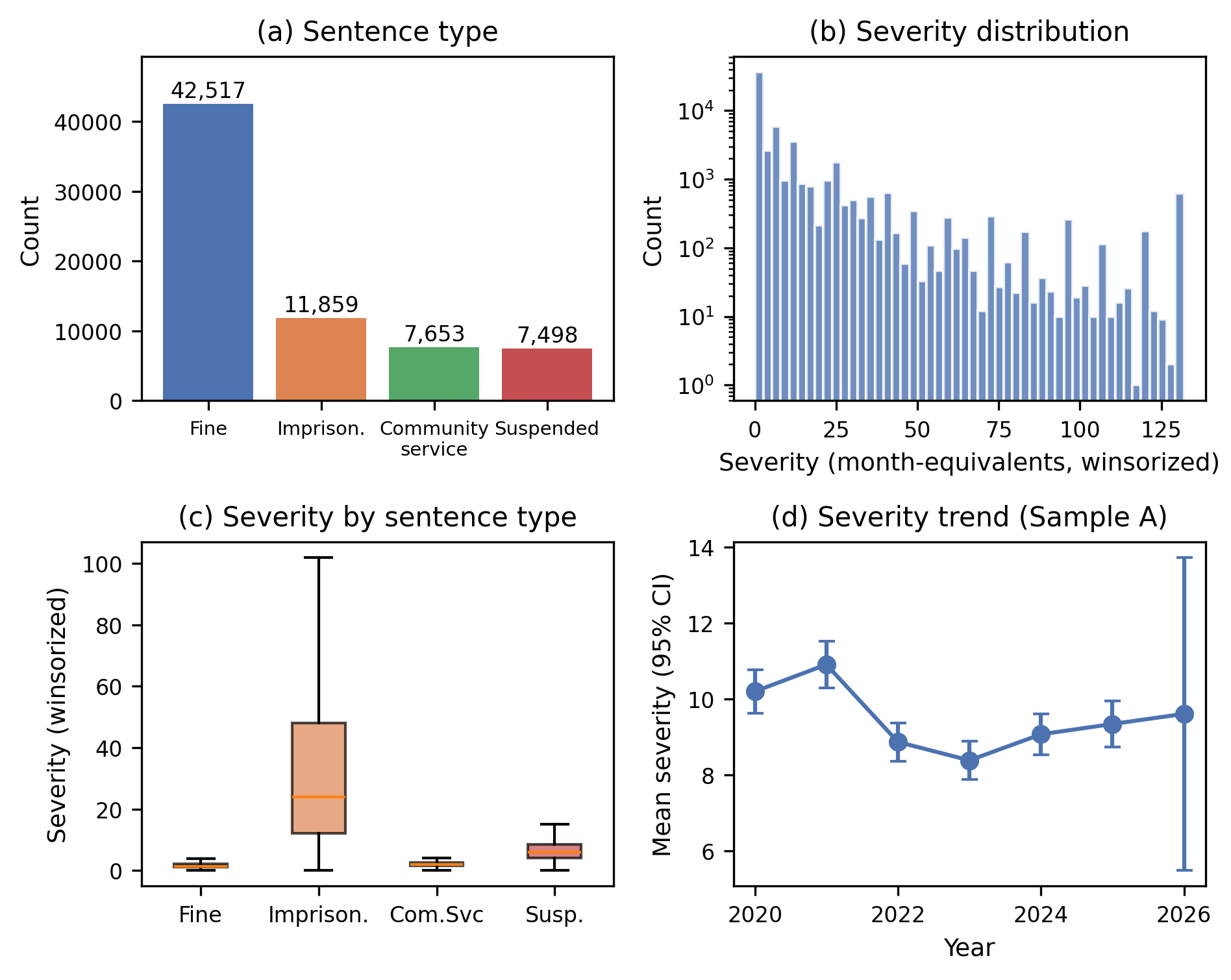
The analysis was preregistered before data collection. The primary model estimates the total association between demographics and severity while adjusting for broad crime category, prior record, year, and court. A second model compares defendants within the same Criminal Code article. These are associations, not estimates of what would happen if a person somehow switched employment status while everything else stayed fixed.
Employment is still the strongest result
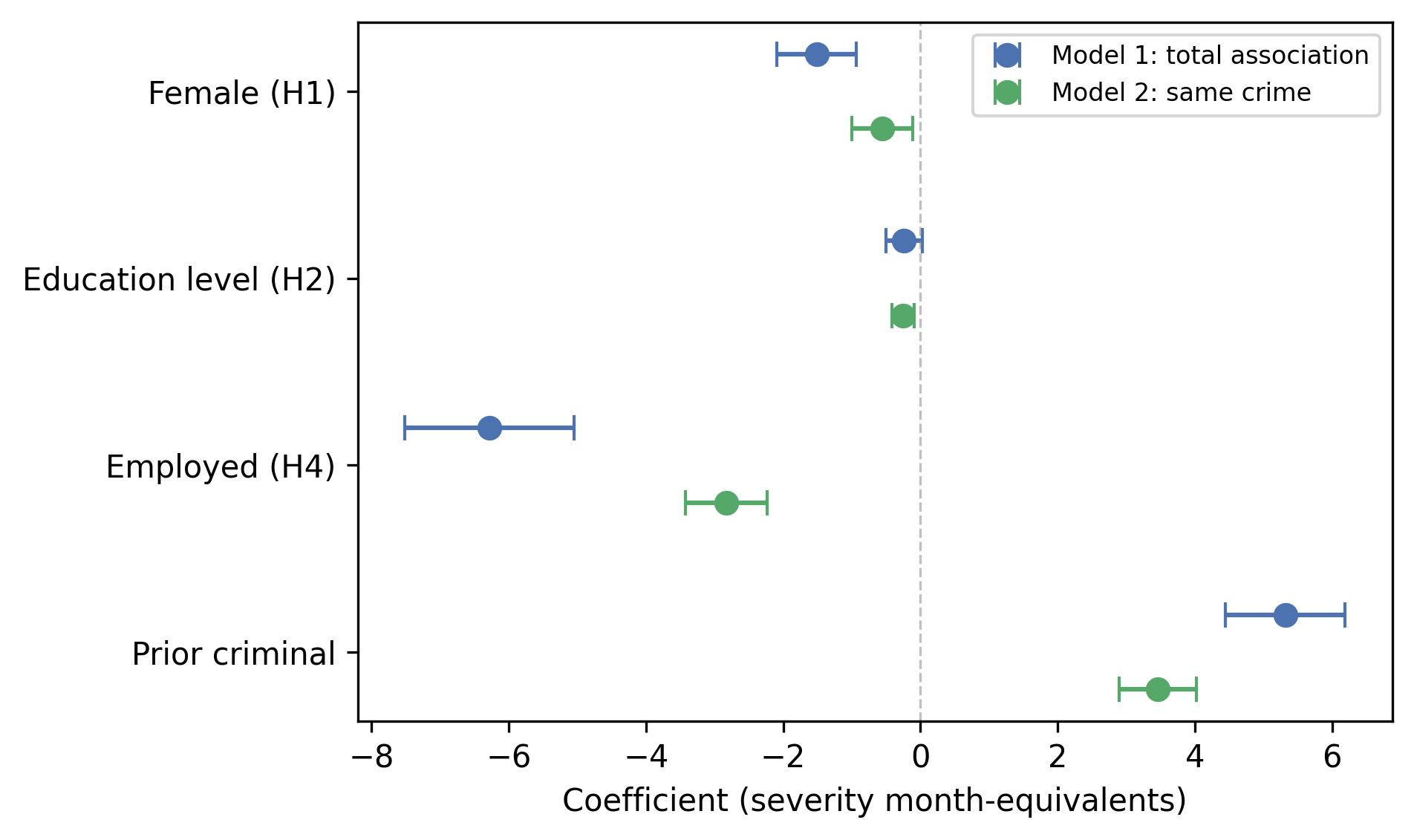
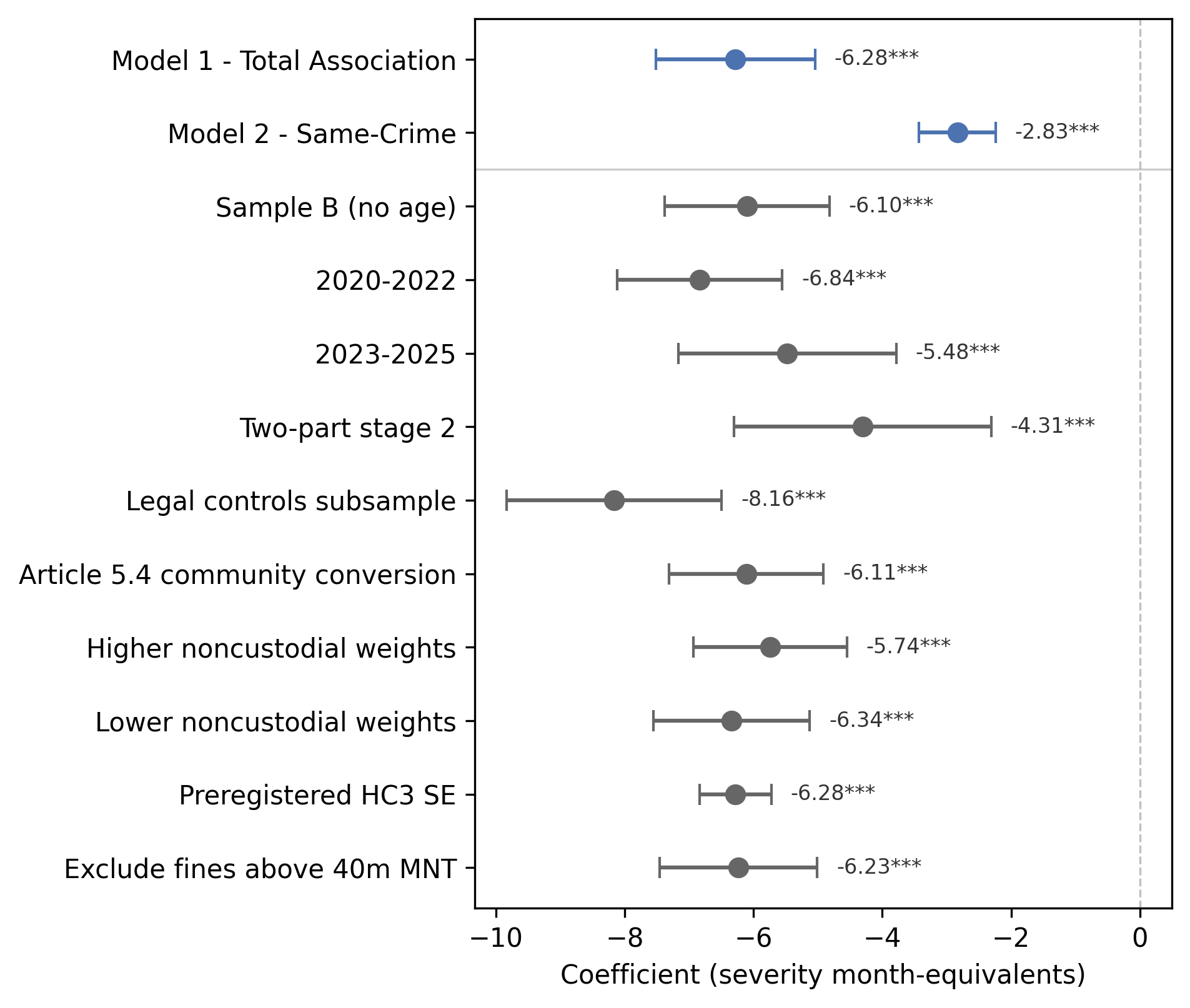
In the primary model, employed defendants receive sentences 6.28 month-equivalents less severe than unemployed defendants with similar observed characteristics. Within the same crime article, the difference narrows to 2.83 months but remains statistically clear.
The employment field itself passed the locked validation threshold. Three separate Codex coding sessions reviewed different parts of a fixed 300-decision sample without seeing the model predictions. Against the 183 cases with both a usable reference label and a prediction, employment accuracy was 97.8% and Cohen’s kappa was 0.956.
This was prediction-blinded LLM-assisted source recoding, not independent human manual validation. That distinction is worth making. The process tests whether the extraction agrees with a separately produced reading of the source, but it does not turn software into a panel of human legal coders through the power of optimistic wording.
The employment association also survives the preregistered HC3 estimator and every cross-sentence conversion I tested.
There is an important complication. Among fine cases alone, employed defendants receive fines about 3.5% higher. Among imprisonment cases, they receive terms about 9.4% shorter. The large aggregate employment gap therefore appears to operate partly through sentence routing, meaning which kind of sentence a defendant receives, rather than through a uniform discount applied to every outcome.
What Mongolian law says about employment
My preliminary article said employment was not a legally prescribed factor and therefore should not matter. That was too simple.
Employment is not one of the mitigating circumstances enumerated in Article 6.5.1 of the Criminal Code. Article 6.1.2 does, however, direct courts to consider the defendant’s broader personal circumstances alongside the offense, harm, mitigation, and aggravation. Employment may enter through that broader inquiry.
The statistical result therefore cannot tell us that courts are applying an illegal employment penalty. It also cannot tell us that the entire difference is legally warranted. Employment may proxy for income, housing stability, ability to pay a fine, representation, offense details, or other circumstances not fully measured in the decisions. The honest finding is narrower: employment is strongly associated with sentence severity after adjustment for the observed controls, and the association persists within the same crime article.
Gender, age, and education
Women receive sentences 1.51 month-equivalents less severe in the primary model and are about 42% less likely to be imprisoned. Among defendants who are imprisoned, however, women receive terms about 3.8 months longer. This does not prove contradictory treatment. It may reflect selection into imprisonment, unmeasured case severity, or both. It does show why a single average coefficient can hide important differences between the decision to imprison and the length of imprisonment.
The registered age nonlinearity is statistically supported in the primary model: severity rises with age and then bends downward. Education is not a reliable predictor in the preferred total-association model after correcting for multiple hypothesis tests.
The model I removed
The preregistration included counts of aggravating and mitigating factors. In the publication audit, aggravating-factor presence had an F1 score of 0.150 and mitigating-factor presence had an F1 score of 0.665, both below the required 0.85. Count errors also exceeded the allowed threshold.
The problem was not random noise. The extractor routinely counted offense elements, narrative facts, party arguments, and personal circumstances that the court had not expressly identified as formal sentencing factors. As a result, the old finding that these factors explained 16.2% of sentencing variation is withdrawn. So is my earlier conclusion that formal legal factors explained four times more variation than demographics.
This was not a fun correction. It was, however, an easy decision once the evidence arrived. A regression can run perfectly on a badly measured variable. The software will not become embarrassed on your behalf.
What I think the evidence supports
The audited results support three conclusions.
First, employment is the clearest demographic disparity in this dataset. Its association with severity is large in the total model, smaller but persistent within the same crime article, and closely connected to sentence routing.
Second, the word bias is stronger than the design permits. These are observational public records with substantial missing demographic data and incomplete measures of case circumstances. The models document disparities conditional on observed variables; they do not establish discriminatory intent or a causal employment penalty.
Third, validation has to be field-specific. The same extraction system measured employment very well, failed badly on formal sentencing factors, and completely misclassified one sentence category. A model name is not a validity certificate.
The preregistration is public on OSF, and the deidentified replication data, code, and aggregate validation evidence are available on GitHub. The public dataset removes direct case identifiers, exact dates, names, occupations, decision text, and the rejected factor fields.
Mongolia’s public court database made this analysis, and its correction, possible. That deserves credit. Transparency is most useful when it allows us not only to find an interesting result, but also to discover when part of that result was wrong.
